I flew back to Lemnos at the end of August for a family I have been photographing for years, and I came home with a folder of images I keep opening for no professional reason at all. The celebration itself was a baptism. The reason I am writing about it is the styling: a full ancient Greece aesthetic built out of terracotta, wheat, olive, eucalyptus and fruit, set up outdoors on a Greek island in late summer light.
If you are planning a wedding, a christening, a name day or a long dinner in Greece and you keep saving images with clay pots and dried grasses in them, this is a breakdown of what actually makes that look work. Not the mood board version. The version that survives an August afternoon on a windy island.
What the Ancient Greece Aesthetic Actually Is (and What It Is Not)
The mistake people make with a Greek theme is going literal. Plastic columns, gold laurel wreaths, anything that looks like it came from a costume shop. It photographs badly and it reads as a party rather than as a place.
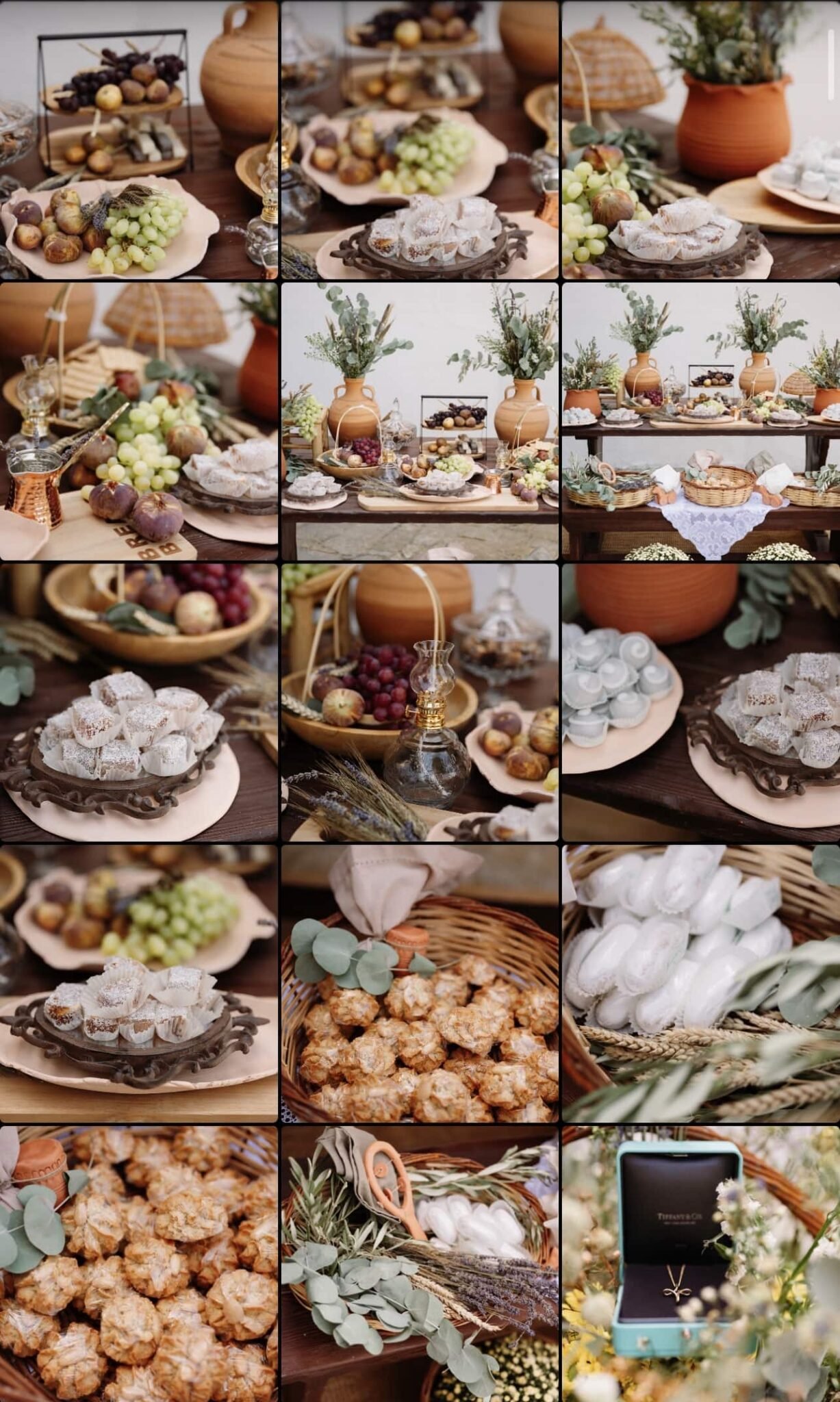
The version that works is closer to an archaeological museum than a toga party. Raw clay, unglazed and unpainted. Dried plant material instead of fresh cut flowers. Fruit served on wood and ceramic rather than glass. Nothing shiny except brass and oil lamps. The palette is entirely made of things that already exist on a Greek island in September: terracotta, wheat, sage, olive green, cream, fig purple.
The test I use: could this table have been set two thousand years ago, allowing for the fact that nobody had eucalyptus? If yes, you are on the right track. If there is anything on the table that only exists because of a party supply shop, take it off.
The Six Elements That Carry the Whole Look
Almost everything on this table came from one of six categories. If you get these right you can skip most other decor entirely, which is also the cheapest way to do it.
1. Terracotta, in more than one shape
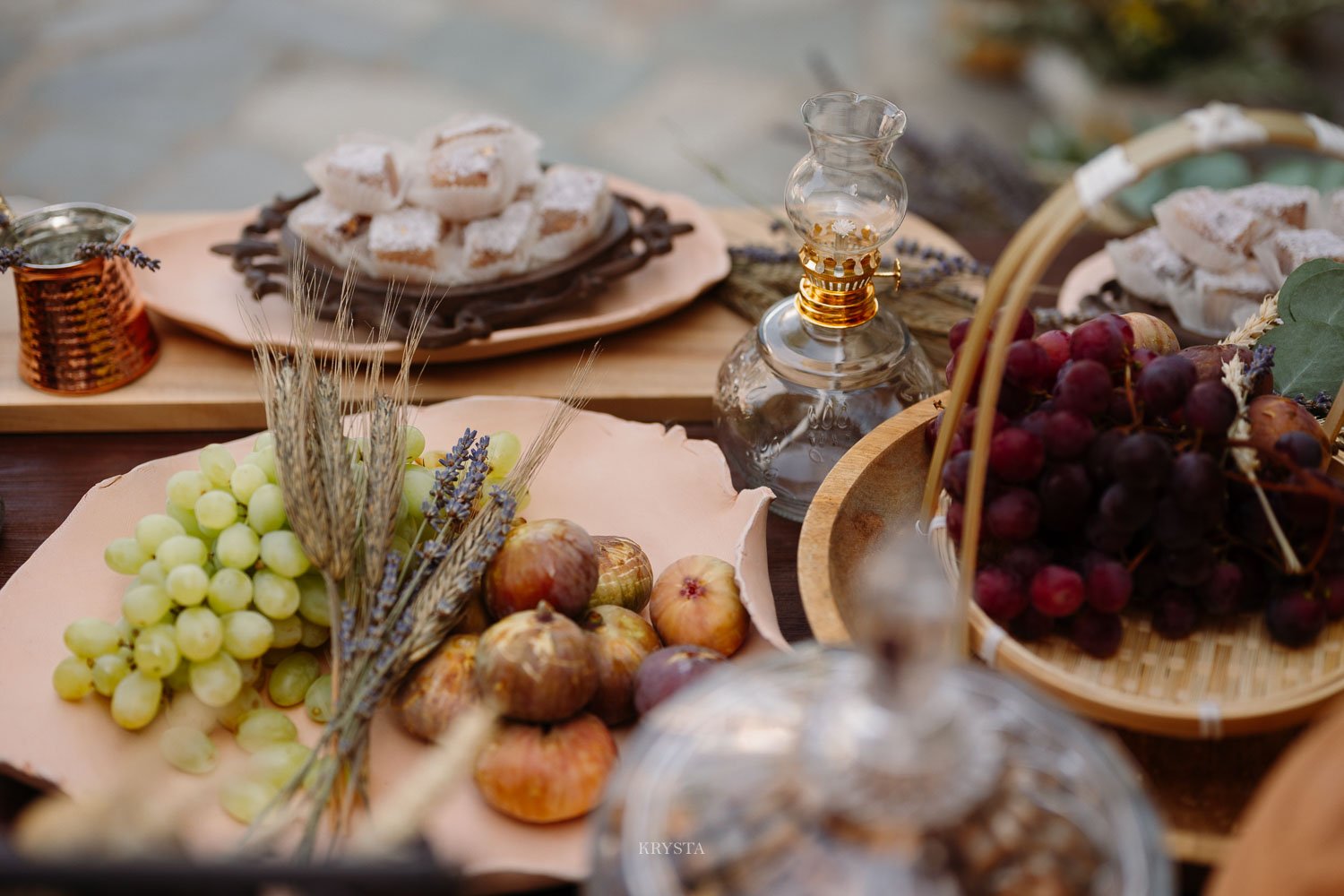
Amphorae for height, wide bowls for fruit, small pots as place markers, one big round vessel as an anchor at the end of the table. Unglazed, so the surface catches light instead of reflecting it. Buying a range of sizes matters more than buying expensive pieces: three identical pots look like a shop display, five different ones look like a household.
2. Dried wheat and grasses
Wheat is the single most underrated material for a Greek summer table. It does not wilt, it does not care about heat, it photographs with a warm edge in almost any light, and it costs almost nothing. Bunch it loosely and let it stick out at odd angles. Trimmed to an even height it looks like a centrepiece; left rough it looks like a harvest.
3. Olive and eucalyptus
Both survive a full day outdoors in Greek heat, which cannot be said for most cut flowers. Olive branches for the silver-green, eucalyptus for the round leaf shapes, and a few bunches of dried lavender for the colour break. I kept seeing eucalyptus tucked into the handles of baskets, which is a small thing that makes a big difference in photographs because it softens every hard edge.
4. Oil lamps and brass
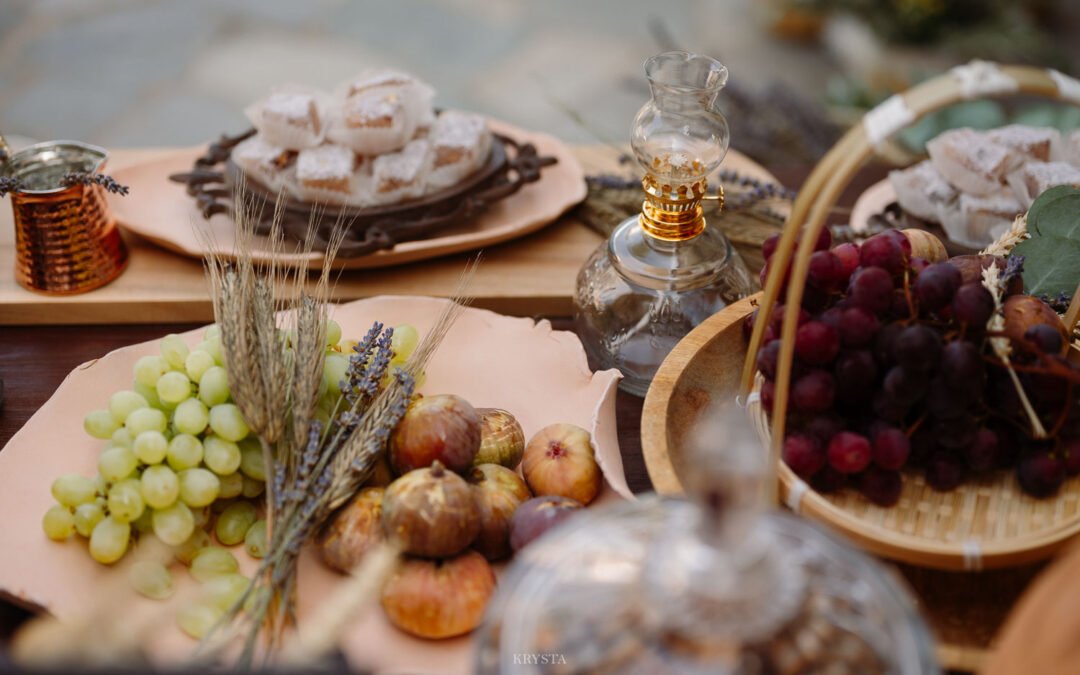
Glass and brass oil lamps do the job that candles usually do, except they hold up in wind and they look correct in daylight as well as at dusk. A copper briki sitting on the table as a prop rather than as coffee equipment is the kind of detail that makes the whole thing read as Greek rather than as generically Mediterranean.
5. Fruit as decor, not as catering
Figs, green and black grapes, small pears, whatever the island has in season. Piled onto raw ceramic platters and left there. Late August on Lemnos means figs are at their best, and a plate of split figs next to a bunch of grapes does more visual work than any floral arrangement at ten times the price.
6. White, in one texture only
The traditional Greek elements, the koufeta in white tulle, the bobonieres, the linen napkins, all stay in one narrow band of white and cream. This is the part people over-complicate. Every white on the table should look like it belongs to the same family, and then the terracotta does the rest.
The Colour Palette, Written Down
If you want to hand something to a decorator or a planner, this is the whole scheme:
- Terracotta and warm clay, as the dominant colour
- Wheat and straw
- Sage and olive green
- Cream and unbleached white
- Fig purple and grape, as the only saturated accent
- Brass, as the only metal
No gold, no blush, no navy, no greenery that is brighter than an olive leaf. The restraint is the whole point. I could have pushed the colour in the edit and made everything warmer and more golden, which is what most of us do with Greek summer images, but the palette was already doing the work and heating it up would have flattened the difference between the clay and the wheat.
Lemnos: An Island That Already Looks Like This
Part of why this styling worked is that it was not fighting the location. Lemnos (also spelled Limnos) sits in the north Aegean, closer to Turkey than to Athens, and it is one of the few Greek islands that has stayed genuinely quiet. No cruise ships, no cliff full of infinity pools, no queue for the sunset. What it has instead is volcanic rock, wheat fields, empty beaches, a working harbour town in Myrina, and light that goes gold about an hour earlier than you expect because there is nothing tall to block it.
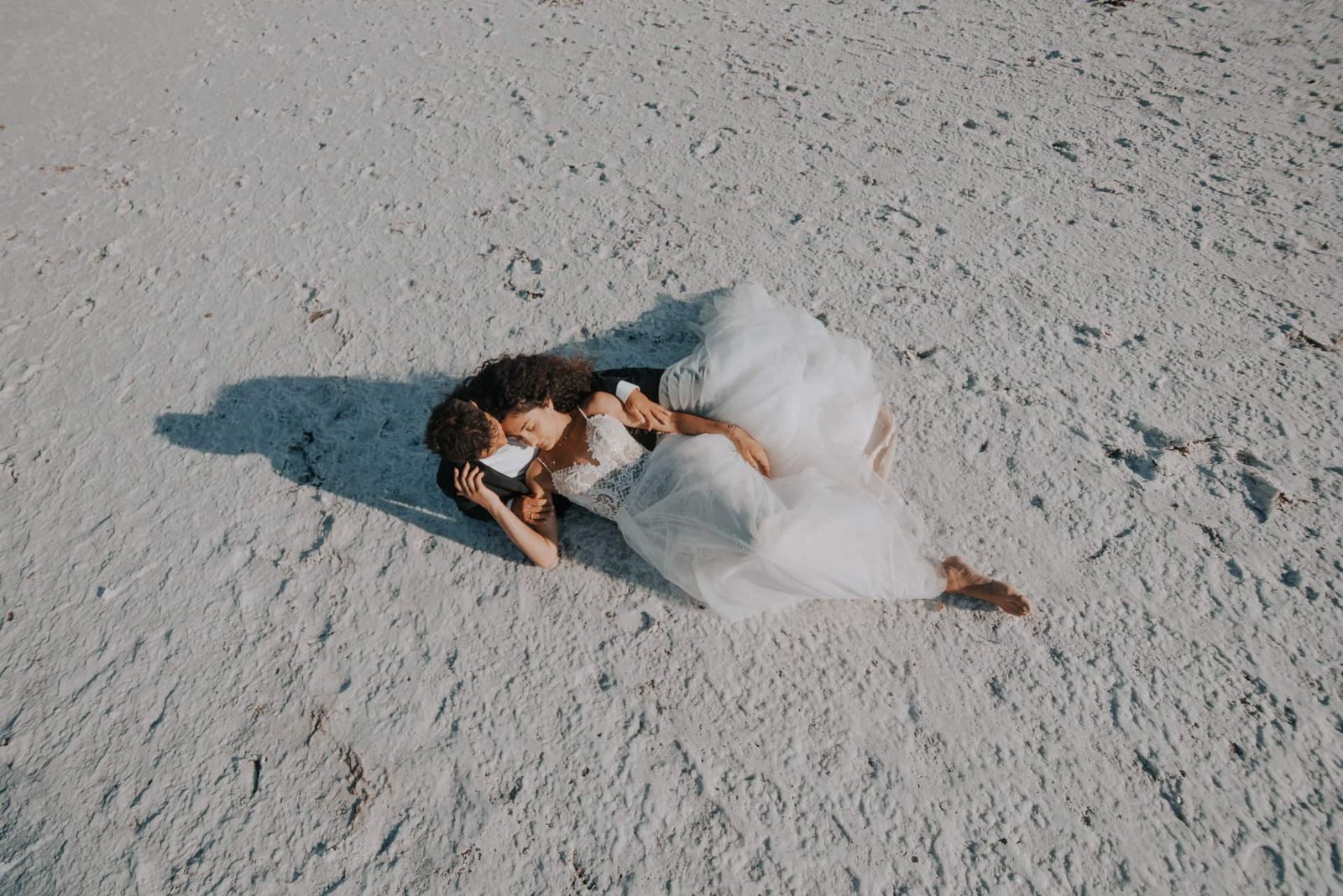
It also has two landscapes that do not look like Greece at all. The Ammothines dunes in the north of the island are a genuine desert, sand as far as you can see, and the Aliki salt lake dries out in summer and leaves a white crust that photographs like snow. We took the family out to Ammothines at seven in the morning with four giant inflatable flamingos, which felt absurd at the time and became funnier once I learned that Lemnos hosts the largest seasonal gathering of real flamingos in Greece, at Aliki, about half an hour away.
Getting Married on Lemnos
I photographed a wedding on Lemnos a few years ago, at the chapel of Saint Nicholas on the rocks with a seaside dinner in Myrina afterwards, and I have wanted to go back ever since. So here is the honest pitch for anyone weighing up a Limnos wedding against the obvious islands.
What Lemnos gives you: privacy, because your guests are not sharing the island with ten thousand other people. Space, because the venues are not booked out two years ahead. Landscape variety that is genuinely unusual, from the dunes to the salt flats to the black volcanic coastline, so a couple's portraits do not look like everyone else's. And a food culture that is worth the trip on its own.
What it costs you: logistics. Lemnos is not a hop from Athens, flights are limited and seasonal, and guests coming from outside Greece will need a connection. That is the real trade. If your guest list is small and travel-willing, it is one of the best decisions you can make. If you have a hundred people flying from four countries, an easier island will save you a lot of email.
I am planning to be back on Lemnos next summer, so if you are considering a wedding or elopement on the island I would genuinely love to hear about it.
What Late August Light Does Here
A practical note for anyone photographing or planning around it. Late August on Lemnos means hard, high sun from roughly ten in the morning until well into the afternoon, and there is very little natural shade outside the villages. Anything you want photographed as a still life, a decorated table, a set of favours, a dessert display, needs to happen early. We shot the full table setup in the morning while it was lit from one side and before a single person had touched it, because a styled table only exists once.
Ammothines is the same problem in a harsher form: no shade, no shelter, no power, and nothing to hide behind. Seven in the morning is not a stylistic choice out there, it is the only window where the sand has any texture and the people in the frame can keep their eyes open.
Planning Notes if You Want to Do Something Like This
A few things that are worth knowing before you brief anyone.
- Buy the vessels, rent the rest. Terracotta is the one category worth owning or sourcing properly, because it is what the whole scheme hangs on and because it survives being packed. Everything else can be borrowed, foraged or bought at a market on the island.
- Source the greenery locally, on the day before. Olive and eucalyptus shipped from the mainland arrive tired. Cut on the island, they last all day in heat.
- Set the table before you need it. Not because of nerves, because of light. A dressed table has one good hour and it is usually early.
- Let the favours do double duty. The handmade clay pieces here worked as decor on the table and then went home with guests, which is the cheapest kind of styling there is.
- Do not hire a theme, hire people who make things. The concept and the planning for this one came from the family, not from an event designer, and that is exactly why it does not look like a Pinterest board executed at scale.
Credits
- Photography: Krystallenia Batzioy from KrystaPhotos (@krystaphotos)
- Footage: @aerialproductions.gr
- Decor and styling: @elichrysos
- Bobonieres and handmade clay favours: @xeiroplathi
- Sweets: @kaspaknes_lixoudies
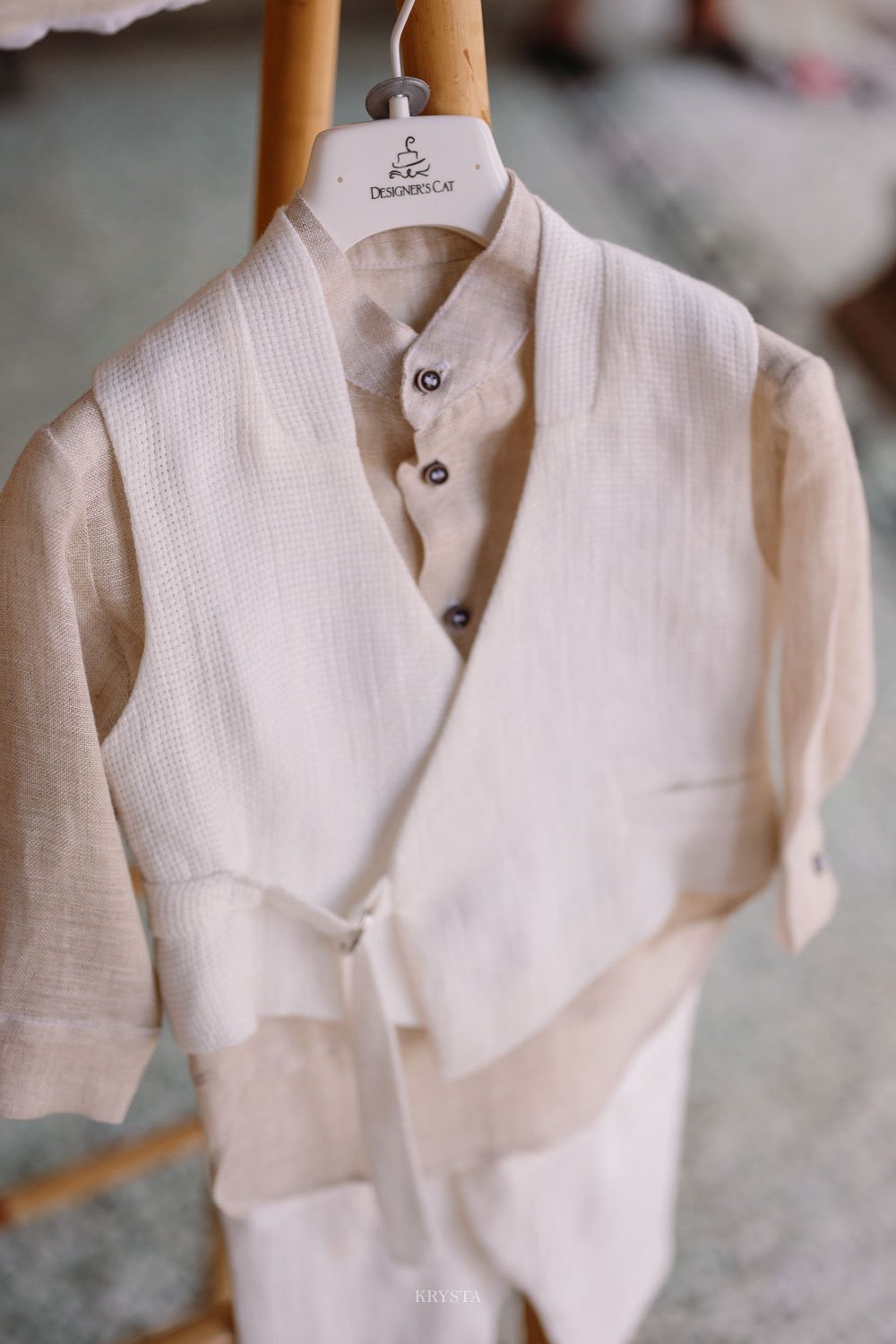
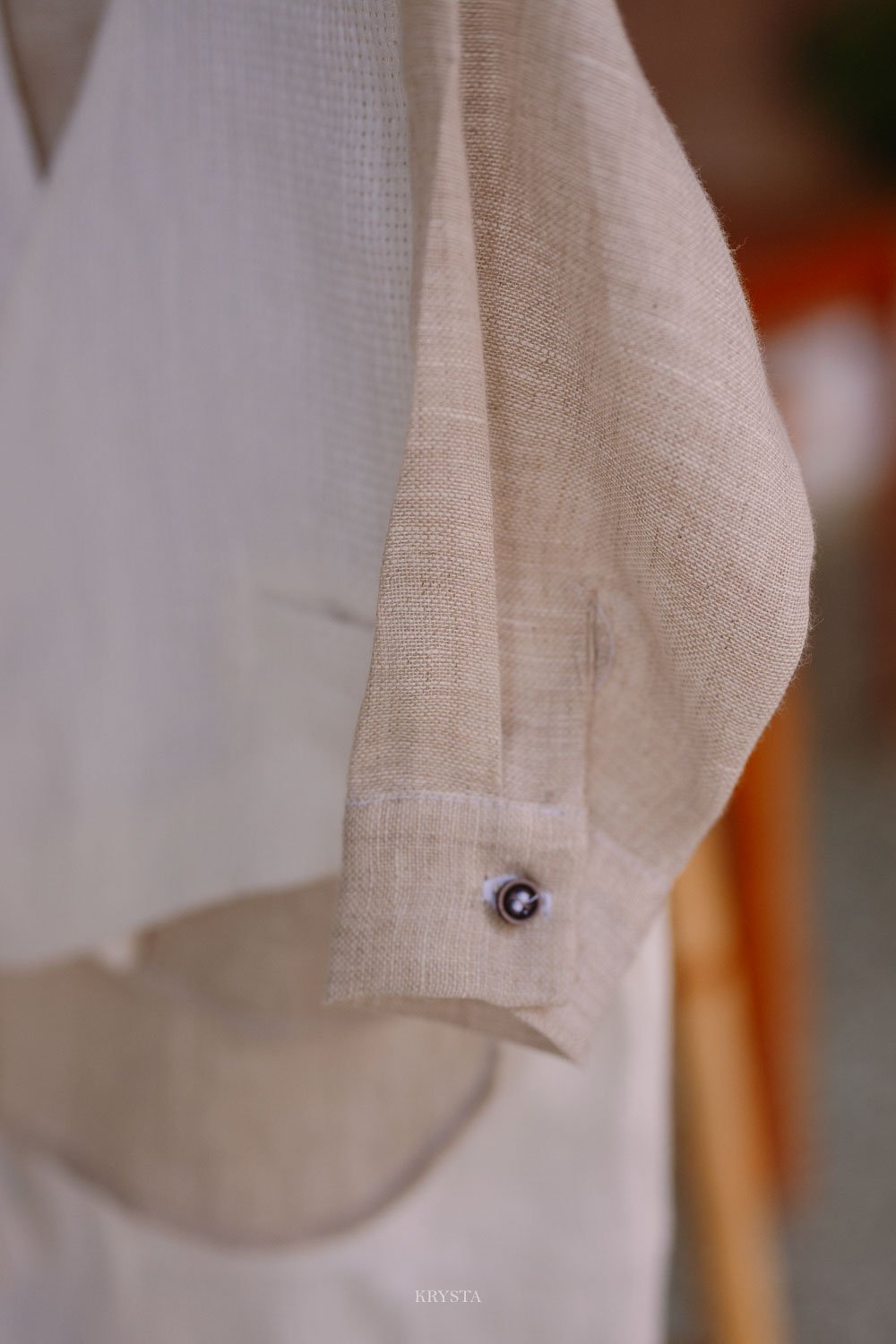
- Outfit: @designers_cat and @bimbo.gr
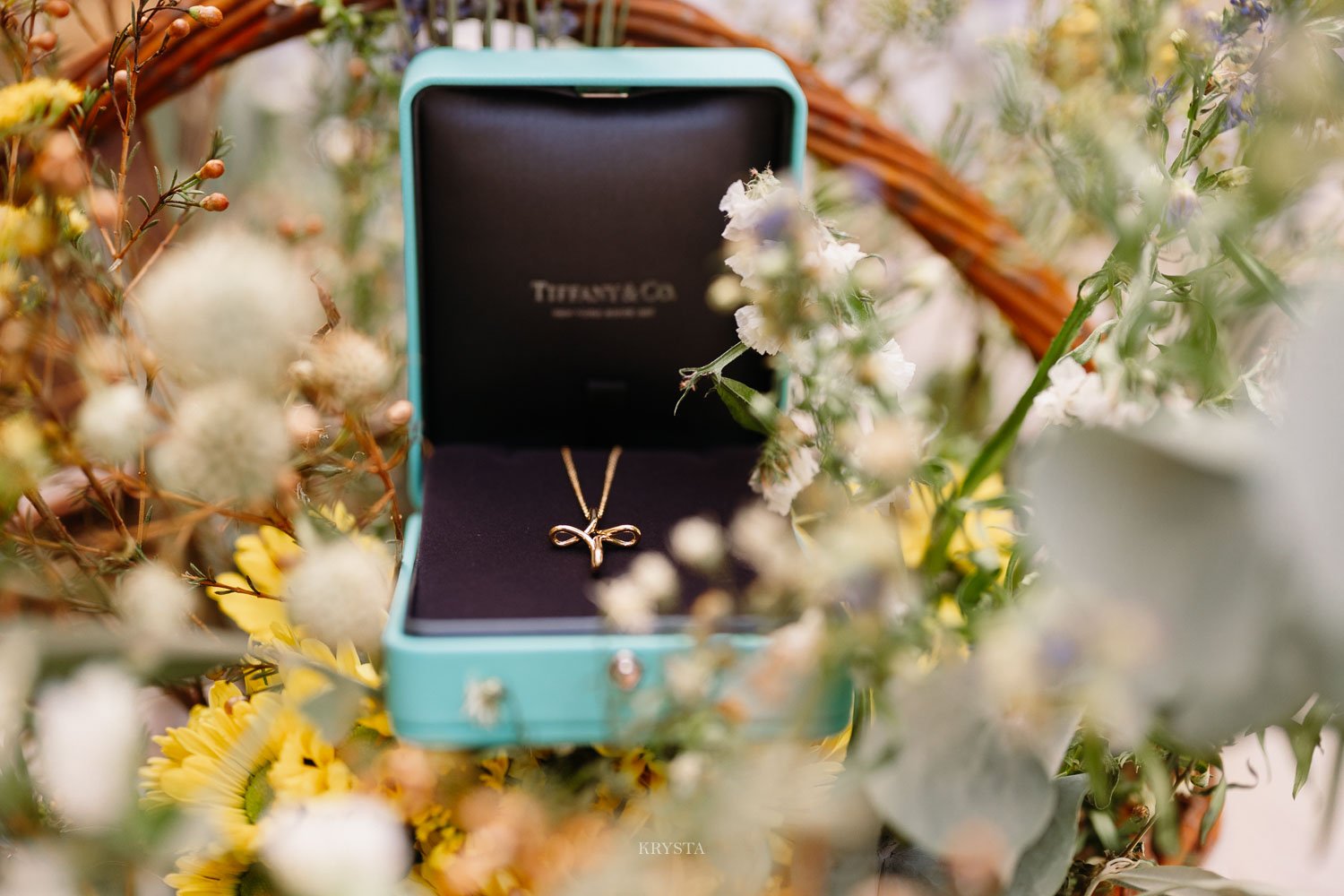
- Golden cross: Tiffany & Co.
- Concept and planning: the family
Photographing in Greece
I shoot weddings, elopements and family celebrations across Greece and Portugal, and Lemnos is high on the list of places I want to keep working. If you are planning something on a Greek island, especially one of the quieter ones, get in touch and tell me what you are thinking. Even if the date does not work out, I will happily tell you what I know about the island.